As generative AI tools become easier to find and use, a thoughtful policy gives staff and patrons a clear understanding of how decisions are made, what safeguards are in place, and what happens when a GenAI tool causes problems.
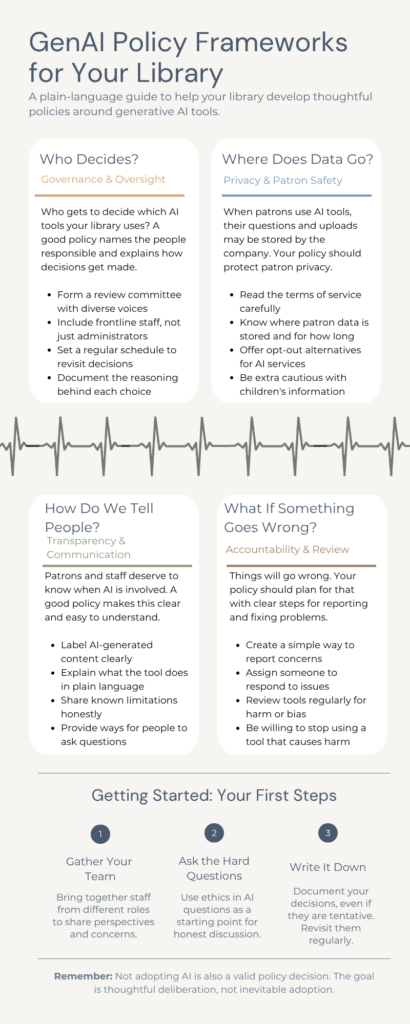
Download this infographic: Feel free to share this resource however it best serves your community. You can download it as a PNG file for quick sharing and web use, as a PDF file for printing and handouts, or access the entire series of infographics as an editable Canva template if you’d like to customize the design, add your library’s branding, or adapt the content for your specific audience.
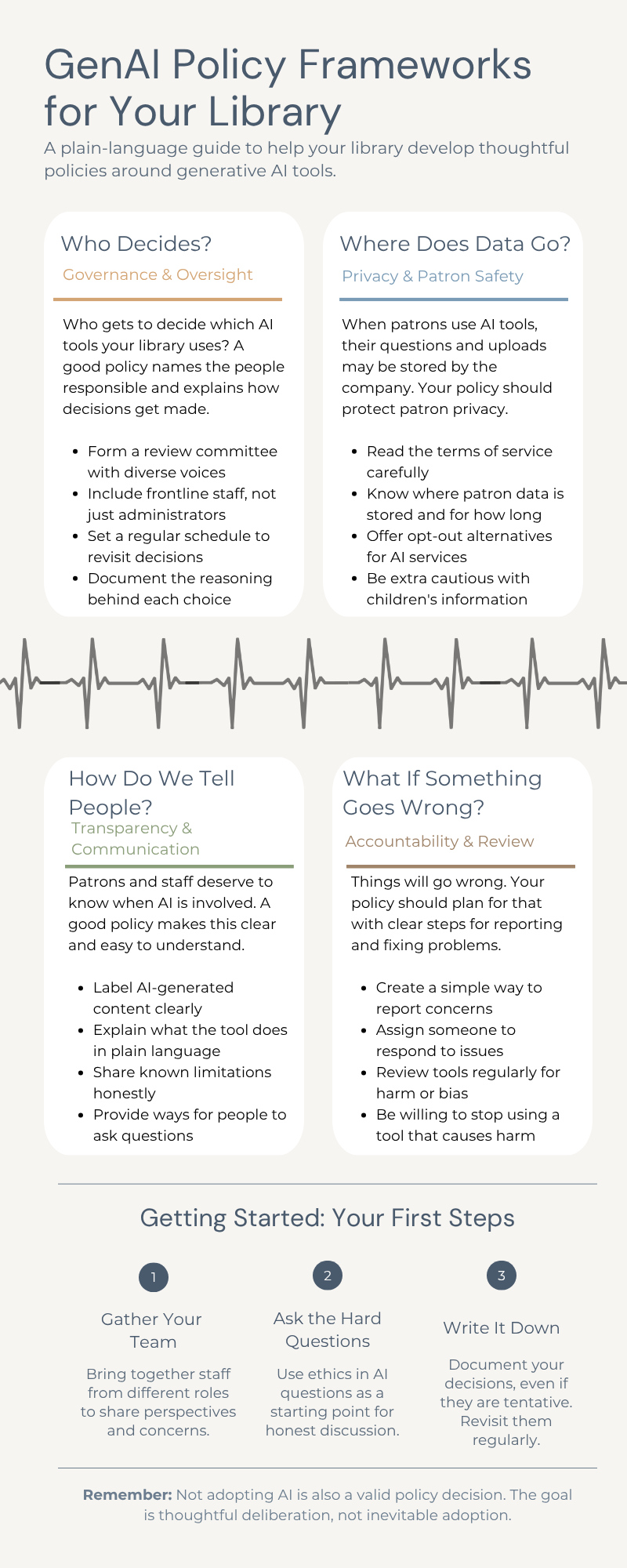
Crafting a GenAI Policy Framework
A useful policy beings with four simple questions: Who decides? Where does data go? How do we tell patrons when AI is being used? What happens if something goes wrong with a GenAI program?
Who Decides? Governance and Oversight
Before choosing a GenAI tool, a library should decide who has a voice in that choice. Decisions made only by administrators may miss concerns that frontline staff encounter every day, such as confusing outputs, patron questions, or barriers to access.
This is why a review group should include people in different roles. A library’s GenAI policy should identify who evaluates proposed tools, who has authority to approve them, and how decisions and the reasoning behind decisions are documented. It should also set a schedule for revisiting decisions. A tool that seemed appropriate when it was first adopted may no longer meet the library’s needs or its standards later on.
Where Does Data Go? Privacy and Patron Safety
When a user enters a question or uploads a document to a GenAI tool, that information may be stored or processed by the company providing it. This often conflicts with library commitments to patron privacy.
Before offering a tool to library patrons, read its terms of service and privacy policy carefully. Find out what information the tool collects, where that information is stored, how long it is retained, and if and how that information is used by the company. A library GenAI policy needs to protect children and their information. It should also provide alternatives for patrons who do not want to use an AI service.
How Do We Tell People? Transparency and Communication
Patrons and staff deserve to know when GenAI is part of a library service or resource. If a tool generates content, helps answer questions, or shapes what someone sees, the library should communicate that clearly.
A GenAI policy can specify when AI-generated content must be labeled, and how staff should use accessible language to explain a GenAI tool’s purpose. Honest discussion of limitations is critical, including ensuring that patrons are aware of the possibility of inaccurate or biased outputs. Library patrons need a straightforward way to ask questions about tools the library uses.
What If Something Goes Wrong? Accountability and Review
Even a carefully evaluated GenAI tool can produce harmful, misleading, or inappropriate results. A library’s GenAI policy should plan for that possibility rather than assuming or hoping that it will not happen.
Staff and patrons need a simple way to report concerns, and someone must be responsible for investigating and responding to these reports. Regular reviews of GenAI tools can help the library identify patterns of error, bias, or other harmful behaviors. Libraries need to be prepared to stop using a tool if the risks outweigh the benefits.
Getting Started
Developing a GenAI policy begins with three manageable steps:
- Gather a team that includes staff from different roles so that discussions reflect a range of experiences and concerns.
- Ask hard questions, including: What problems would this tool solve? What might it cost patrons, staff, or the community? Who benefits? Who might be harmed? These ethical considerations for librarians using GenAI offer a solid starting point
- Write down decisions that are made, even if they are tentative. Set a schedule to regularly revisit these decisions.
Remember that choosing not to adopt a GenAI tool is a valid policy decision.
Further Reading
American Library Association. (n.d.). Artificial intelligence. https://www.ala.org/future/trends/artificialintelligence
This collection of resources gathers the ALA’s evolving guidance on AI in libraries, including ethics, instruction, and policy.
American Library Association. (2021). Code of Ethics. https://www.ala.org/tools/ethics
This foundational document articulates how professional values including intellectual freedom, equitable access, and a commitment to accuracy inform how librarians should approach emerging technologies. It offers a shared vocabulary for discussing generative AI’s implications for privacy, information integrity, and service to users.
American Library Association. (2021, October). Privacy. https://www.ala.org/advocacy/privacy. This is a good starting point for thinking through patron confidentiality and questions that should be asked before sending patron or library data to any third-party tool.
Cox, A. M., & Tzoc, E. (2023). ChatGPT: Implications for academic libraries. College & Research Libraries News, 84(3), 99–102. https://doi.org/10.5860/crln.84.3.99 This widely cited piece includes a discussion of opportunities and risks.
International Federation of Library Associations and Institutions. (2020). IFLA Statement on Libraries and Artificial Intelligence. https://repository.ifla.org/rest/api/core/bitstreams/8d21df6c-e61b-41a5-b089-0353a5552dbd/content This statement offers an international, values-based perspective on how libraries should engage with AI. It connects AI decisions tso library values, including access to information, privacy, and professional responsibility.
NIST. (2024, July). Artificial intelligence risk management framework: Generative Artificial Intelligence profile. https://nvlpubs.nist.gov/nistpubs/ai/NIST.AI.600-1.pdf . This document offers an overview of risks that are unique to or exacerbated by GenAI.
Fengchun, M., & Wayne, H. (2023). Guidance for generative AI in education and research. UNESCO. https://doi.org/10.54675/EWZM9535. Guidance for a human-centered approach to using generative AI in education and research.