Generative AI can help librarians draft materials, explore ideas, and support everyday work. But deciding whether to use a tool involves more than asking whether it saves time. Libraries also have commitments to intellectual freedom, patron privacy, equitable access, and responsible stewardship. Viewing GenAI use through the lens of those commitments is a critical starting point for evaluating ethical GenAI use in libraries.
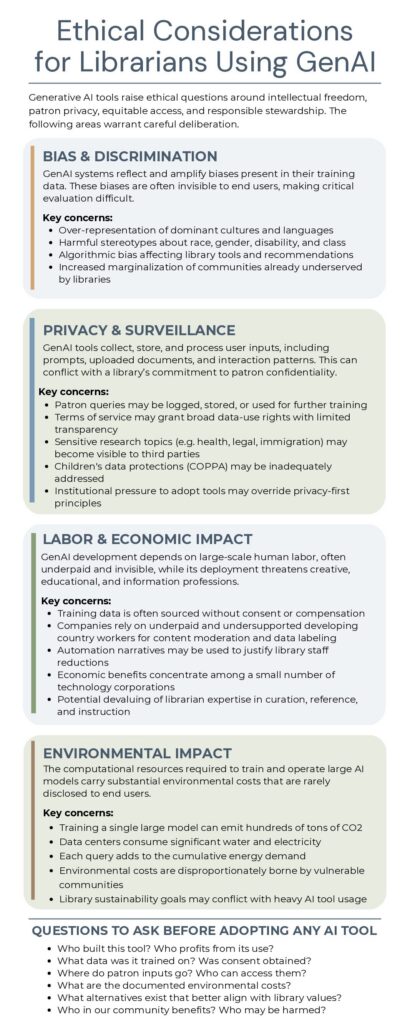
Download this infographic: Feel free to share this resource however it best serves your community. You can download it as a PNG file for quick sharing and web use, as a PDF file for printing and handouts, or access the entire series of infographics as an editable Canva template if you’d like to customize the design, add your library’s branding, or adapt the content for your specific audience.
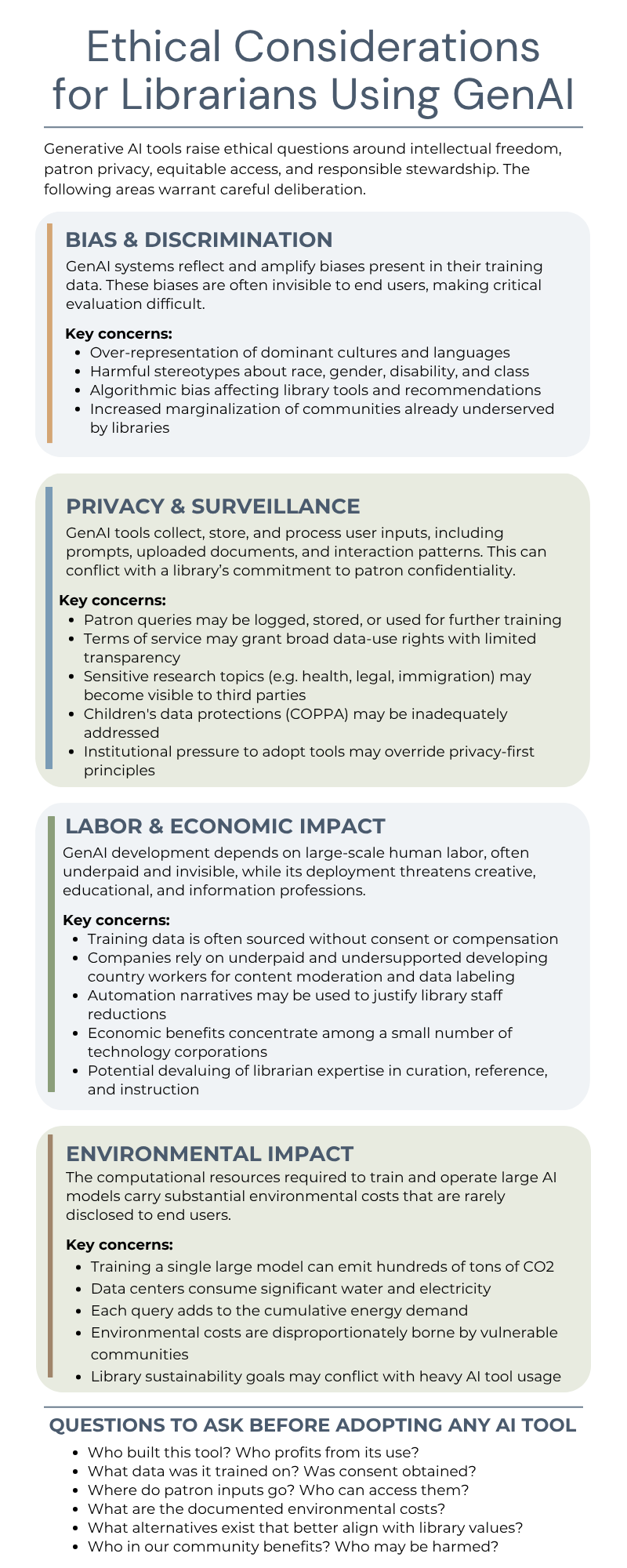
Ethical Considerations for Librarians Using GenAI
Bias and Discrimination in GenAI
GenAI systems learn from large collections of data that reflect existing inequalities. As a result, their outputs can repeat stereotypes, favor dominant cultures and languages, or overlook the experiences of communities that libraries have historically underserved. These biases are not always obvious, especially when a response sounds confident or polished.
For librarians, the concern extends beyond an occasional inaccurate answer. If a biased tool helps generate recommendations, descriptions, or instructional materials, it may shape what patrons can find and how they are represented. Librarians should examine GenAI outputs critically, seek perspectives missing from the results, and understand that an AI response is not a neutral source.
Privacy and Surveillance Concerns
People may enter sensitive details into a GenAI tool: a research question, a draft document, a personal concern, or details about someone else. Depending on the tool and its settings, these inputs may be logged, retained, reviewed, or used to improve the service. Gen AI tool privacy practices may not align with a library’s commitment to protecting patron confidentiality.
Before adopting a tool, librarians should ask where inputs go, how long they are kept, who can access them, and whether they are used for training. Extra care is needed with sensitive research topics (e.g. health, legal, and immigration research) and with services used by children as children’s data protections (COPPA) may not be addressed adequately. Institutional pressure to adopt AI quickly should not take precedence over a careful review of privacy risks.
The Labor and Economic Impact of Artificial Intelligence
GenAI may appear to produce results automatically, but people contribute substantial labor to its development. Workers label data, moderate harmful content, and perform other tasks that can be underpaid or difficult to see. Training data may also include creative work used without its creators’ consent or compensation.
The effects of GenAI in libraries deserve scrutiny, too. Claims that it can “replace” professional tasks may be used to justify staffing cuts while overlooking the expertise involved in reference, instruction, and curation. Libraries should consider who benefits financially from a tool, whose labor makes it possible, and whether adopting it supports or undermines the people who provide library services.
AI’s Environmental Impact
Training and operating large AI models requires electricity, computing equipment, and, in many cases, water for data-center cooling. The impact varies by model, provider, infrastructure, and type of use, so a simple figure rarely tells the whole story. Still, routine use across many people and institutions can add to a substantial resource demand.
Environmental costs may also fall unevenly on communities near data centers or energy infrastructure. A library with sustainability goals should weigh a tool’s benefits against its resource use and ask providers for meaningful information about their environmental practices.
Questions to Ask Before Adopting an AI Tool
Start an ethical with a few practical questions:
- Who built this tool? Who profits from its use?
- What data was it trained on? Was consent obtained?
- Where do patron inputs go? Who can access them?
- What are the documented environmental costs?
- Are there alternatives that better align with library values?
- Most importantly, who in the community benefits? Who might be harmed?
GenAI tools will continue to change, and no single checklist can settle every question. By asking these questions before adoption, librarians can make decisions grounded in their profession’s values rather than using a new technology simply because it is available.
This portion of the site is funded by the 2025-26 SIG-IEP & ASIS&T student research grant on AI governance. Learn more.
Further Reading
Child Safety
Federal Trade Commission. (1998). Children’s Online Privacy Protection Rule (“COPPA). https://www.ftc.gov/legal-library/browse/rules/childrens-online-privacy-protection-rule-coppa
“COPPA imposes certain requirements on operators of websites or online services directed to children under 13 years of age, and on operators of other websites or online services that have actual knowledge that they are collecting personal information online from a child under 13 years of age.”
Content Moderation Mental Health Research
Martinez-Sadurni, L., Casanovas, F., Llimona, C., Garcia, D., Rodriguez-Seoane, R., & Castro, J. I. (2024). Secondary trauma by internet content moderation: A case report. European Psychiatry, 67(Suppl 1), S666. https://doi.org/10.1192/j.eurpsy.2024.1383]
Pendse, S.R., Gergle, D., Kornfield, R., Meyerhoff, J., Mohr, D., Suh, J., Wescott, A., Williams, C., & Schleider, J. (2025). When testing AI tests us: Safeguarding mental health on the digital frontlines. Association for Computing Machinery, Proceedings of the 2025 ACM Conference on Fairness, Accountability, and Transparency (FAccT ’25), 1793–1804. https://doi.org/10.1145/3715275.3732120
Ryan, M. Trauma behind the algorithm: a phenomenological analysis of violent content data work. AI Ethics 6, 430 (2026). https://doi.org/10.1007/s43681-026-01282-1
Copyright, Consent, and Training Data
Authors Guild. (n.d.). Artificial intelligence. https://authorsguild.org/advocacy/artificial-intelligence/
The Authors Guild documents the perspective of writers whose work has been used to train AI systems, making it a valuable source for the consent and compensation concerns raised in this post. It grounds the abstract issue of training data in the real experiences of creators.
U.S. Copyright Office. (2025). Copyright and artificial Intelligence. https://www.copyright.gov/ai/
This ongoing report series offers a credible institutional source on the copyright questions surrounding AI training data and output.
Environmental Costs
Ngugyen, T., & Green, B. (2025, July). What happens when data centers come to town? University of Michigan. https://stpp.fordschool.umich.edu/sites/stpp/files/2025-07/stpp-data-centers-2025.pdf
Shirvell, B. (2026, July 10). Data centers, urban heat, and AI growth. Yale School of the Environment. https://environment.yale.edu/news/article/data-centers-urban-heat-and-ai-growth
Walker, C.D., & Goldsmith, I. (2026, February 17). From energy use to air quality, the many ways data centers affect US communities. World Resources Institute. https://www.wri.org/insights/us-data-center-growth-impacts
For the Library Profession
American Library Association. (n.d.). Artificial intelligence. https://www.ala.org/future/trends/artificialintelligence
This collection of resources gathers the ALA’s evolving guidance on AI in libraries, including ethics, instruction, and policy.
American Library Association. (2021). Code of Ethics. https://www.ala.org/tools/ethics
This foundational document articulates how professional values including intellectual freedom, equitable access, and a commitment to accuracy inform how librarians should approach emerging technologies. It offers a shared vocabulary for discussing generative AI’s implications for privacy, information integrity, and service to users.
Cox, A. M., & Tzoc, E. (2023). ChatGPT: Implications for academic libraries. College & Research Libraries News, 84(3), 99–102. https://doi.org/10.5860/crln.84.3.99 This widely cited piece includes a discussion of opportunities and risks.
International Federation of Library Associations and Institutions. (2020). IFLA Statement on Libraries and Artificial Intelligence. https://repository.ifla.org/rest/api/core/bitstreams/8d21df6c-e61b-41a5-b089-0353a5552dbd/content This statement offers an international, values-based perspective on how libraries should engage with AI. It complements the ALA materials by situating the conversation within a global professional context.
Pingback: Generative AI Resources for Librarians – Librarian Ed