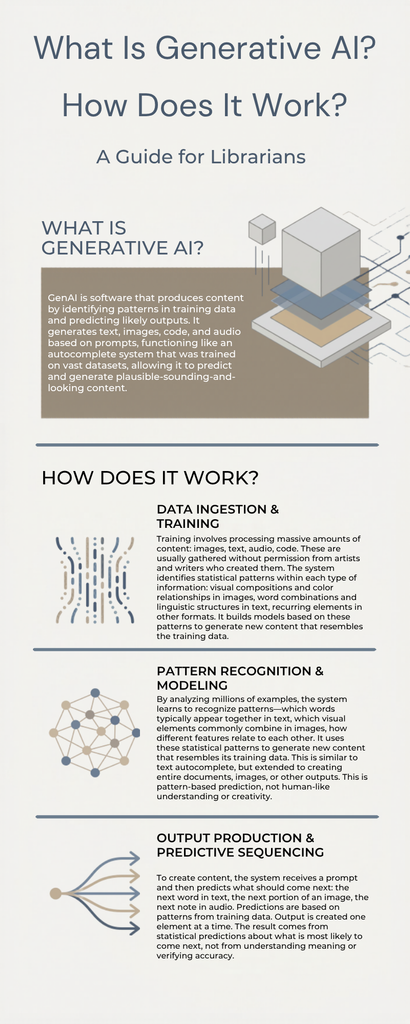
Download this infographic: Feel free to share this resource however it best serves your community. You can download it as a PNG file for quick sharing and web use, as a PDF file for printing and handouts, or as an editable Canva template if you’d like to customize the design, add your library’s branding, or adapt the content for your specific audience.
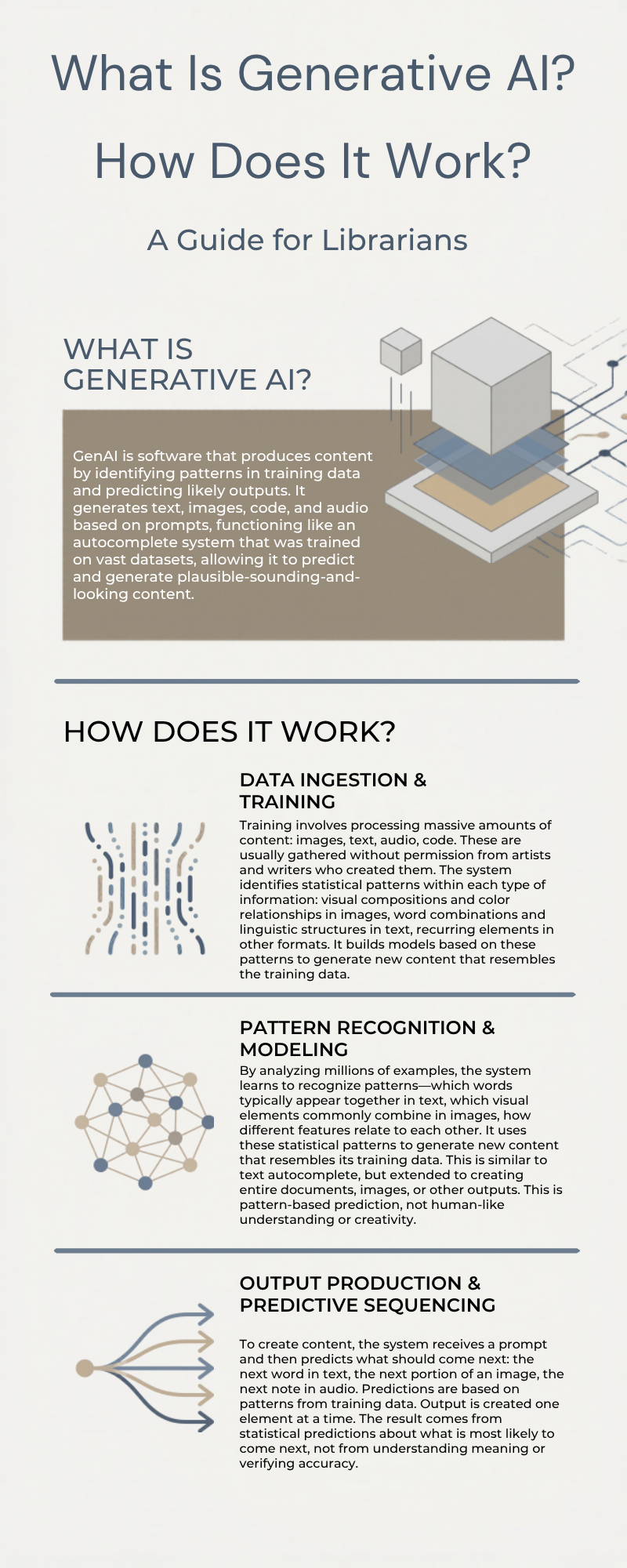
What Is Generative AI? A Guide for Librarians
As artificial intelligence tools become more common in patron requests, research workflows, and even our own library operations, understanding what generative AI actually is and how it works is critical knowledge for information professionals. Librarians are uniquely positioned to help their communities navigate these tools, but doing so requires a clear grasp of the technology beneath the buzzwords. This post, along with the accompanying infographic, breaks down the fundamentals in plain language so you can confidently explain generative AI to colleagues, students, and patrons alike.
At its core, generative AI is software that produces content by identifying patterns in training data and predicting likely outputs. Whether it’s generating text, images, code, or audio, the technology works much like an autocomplete system that has been trained on enormous datasets. This training allows it to predict and generate content that sounds and looks plausible. Rather than thinking of these tools as “knowing” things, we can understand them as producing statistically likely combinations of words or pixels based on what they’ve seen before.
The process unfolds in three broad stages:
Step 1: Data Ingestion and Training
First comes data ingestion and training, in which the system processes massive amounts of content: images, text, audio, and code, much of it gathered without the permission of the artists and writers who created it. During this phase, the system identifies statistical patterns within each type of information, such as visual compositions and color relationships in images, or word combinations and linguistic structures in text.
Step 2: Pattern Recognition and Modeling
Next is pattern recognition and modeling. Here the system, having analyzed millions of examples, learns which words typically appear together, how visual elements combine, and how features relate to one another. This is pattern-based prediction, not human-like understanding or creativity.
Step 3: Output Production and Predictive Sequencing
In output production and predictive sequencing, the system receives a prompt and predicts what should come next: the next word, the next portion of an image, the next note of audio. Content is generated one element at a time using statistical predictions about what is most likely to follow, not from any comprehension of meaning or verification of accuracy.
Understanding these mechanics is essential for the reference and information literacy work at the heart of librarianship. Because generative AI predicts plausibility rather than truth, it can produce confident-sounding but inaccurate results. This makes our role in teaching source evaluation and critical thinking more valuable than ever. We hope this guide serves as a useful starting point for those conversations in your own library.
Note: Graphics and design elements supplied via Canva.
This portion of the site is funded by the 2025-26 SIG-IEP & ASIS&T student research grant on AI governance. Learn more.
Further Reading
For Foundational Understanding
Google. (2023). What is generative AI? Ask a Techspert. https://blog.google/company-news/inside-google/googlers/ask-a-techspert/what-is-generative-ai/
Part of Google’s “Ask a Techspert” series, this post offers a friendly, conversational explanation of how generative AI works and what distinguishes it from other kinds of AI. Its plain-language, question-and-answer approach makes it especially easy to share with patrons who are new to the topic.
IBM. (n.d.). What is generative AI? https://www.ibm.com/topics/generative-ai
IBM’s explainer walks through the mechanics of generative AI training, modeling, and output in plain language. It pairs well with the three-stage process described in this post and is a reliable resource to recommend to patrons seeking a thorough foundational understanding.
Stanford Institute for Human-Centered Artificial Intelligence. (2026). Artificial Intelligence Index Report. https://aiindex.stanford.edu
Published annually, this data-rich report is an authoritative reference for statistics on AI development, adoption, and capabilities. Use it when you want to support claims about the scale of training data or the pace of the field’s growth.
On Copyright, Consent, and Training Data
Authors Guild. (n.d.). Artificial intelligence. https://authorsguild.org/advocacy/artificial-intelligence/
The Authors Guild documents the perspective of writers whose work has been used to train AI systems, making it a valuable source for the consent and compensation concerns raised in this post. It grounds the abstract issue of training data in the real experiences of creators.
U.S. Copyright Office. (2025). Copyright and artificial Intelligence. https://www.copyright.gov/ai/
This ongoing report series offers a credible institutional source on the copyright questions surrounding AI training data and output. It speaks directly to the consent issues this post raises and carries the weight of a federal agency.
For the Library Profession
American Library Association. (n.d.). Artificial intelligence. https://www.ala.org/future/trends/artificialintelligence
This collection of resources gathers the ALA’s evolving guidance on AI in libraries, including ethics, instruction, and policy. It is a natural starting point for connecting the general concepts in this post to professional practice.
American Library Association. (2021). Code of Ethics. https://www.ala.org/tools/ethics
This foundational document articulates how professional values including intellectual freedom, equitable access, and a commitment to accuracy inform how librarians should approach emerging technologies. It offers a shared vocabulary for discussing generative AI’s implications for privacy, information integrity, and service to users.
Association of College and Research Libraries. (2015). Framework for Information Literacy for Higher Education. https://www.ala.org/acrl/standards/ilframework Although it predates the current wave of generative AI tools, this framework underpins the argument that librarians are essential guides for source evaluation and critical thinking. It offers language and concepts you can draw on directly when designing instruction around AI-generated content.
Cox, A. M., & Tzoc, E. (2023). ChatGPT: Implications for academic libraries. College & Research Libraries News, 84(3), 99–102. https://doi.org/10.5860/crln.84.3.99 This widely cited piece examines how generative AI tools intersect with core library functions such as reference, instruction, and collection development. Though framed around academic libraries, its practical discussion of opportunities and risks translates well to public and school settings.
International Federation of Library Associations and Institutions. (2020). IFLA Statement on Libraries and Artificial Intelligence. https://repository.ifla.org/rest/api/core/bitstreams/8d21df6c-e61b-41a5-b089-0353a5552dbd/content This statement offers an international, values-based perspective on how libraries should engage with AI. It complements the ALA materials by situating the conversation within a global professional context.
Pingback: Generative AI Resources for Librarians – Librarian Ed